
AI Worker Partnership Study 2025: Stanford Reveals Truth
TL;DR: Stanford's 2025 study proves workers want AI partnership, not replacement. 45.2% prefer equal collaboration, yet 41% of investments miss the mark.
Quick Take: Stanford's 2025 study of 1,500 workers proves AI's future is partnership, not replacement. 45.2% prefer equal collaboration (H3 level), yet 41% of AI investments target areas workers don't want automated.
TL;DR: The real 2025 AI revolution isn't about robots replacing us - it's about partnership. Stanford's landmark study of 1,500 workers proves it: people want collaboration, not blind automation. Yet 41% of AI investments miss the mark, targeting areas employees don't even want to automate.

Hi, I'm Dr. Hernani Costa, AI CxO Founder at First AI Movers. After 25+ years in tech, bringing ethical, human-centered AI to leaders and SMEs, I've learned that sustainable innovation is built on trust - not tech alone. This article translates new research into a practical playbook to help you align your AI strategy with what actually works for humans and business.
You'll discover:
- How and why worker preferences are flipping AI wisdom on its head.
- The Human Agency Scale (H1–H5) - a new language for partnership with AI.
- Four AI adoption zones to target investments with confidence and minimize regret.
- Where most organizations go wrong - and steps to avoid wasted effort.
- Which "human" skills now command premiums in the AI age.
- Real-world, actionable steps you can take to future-proof your team and technology.
By the end, you'll know how to position your business not for an AI takeover, but for sustainable, human-centered AI success in 2025 and beyond.
What Does Stanford's 2025 AI Study Reveal About Worker Preferences?
Stanford's research reveals workers don't want AI takeovers - they want AI teammates. The study found 45.2% of workers prefer H3-level "Equal Partnership" with AI, where humans and machines share responsibility for task completion.
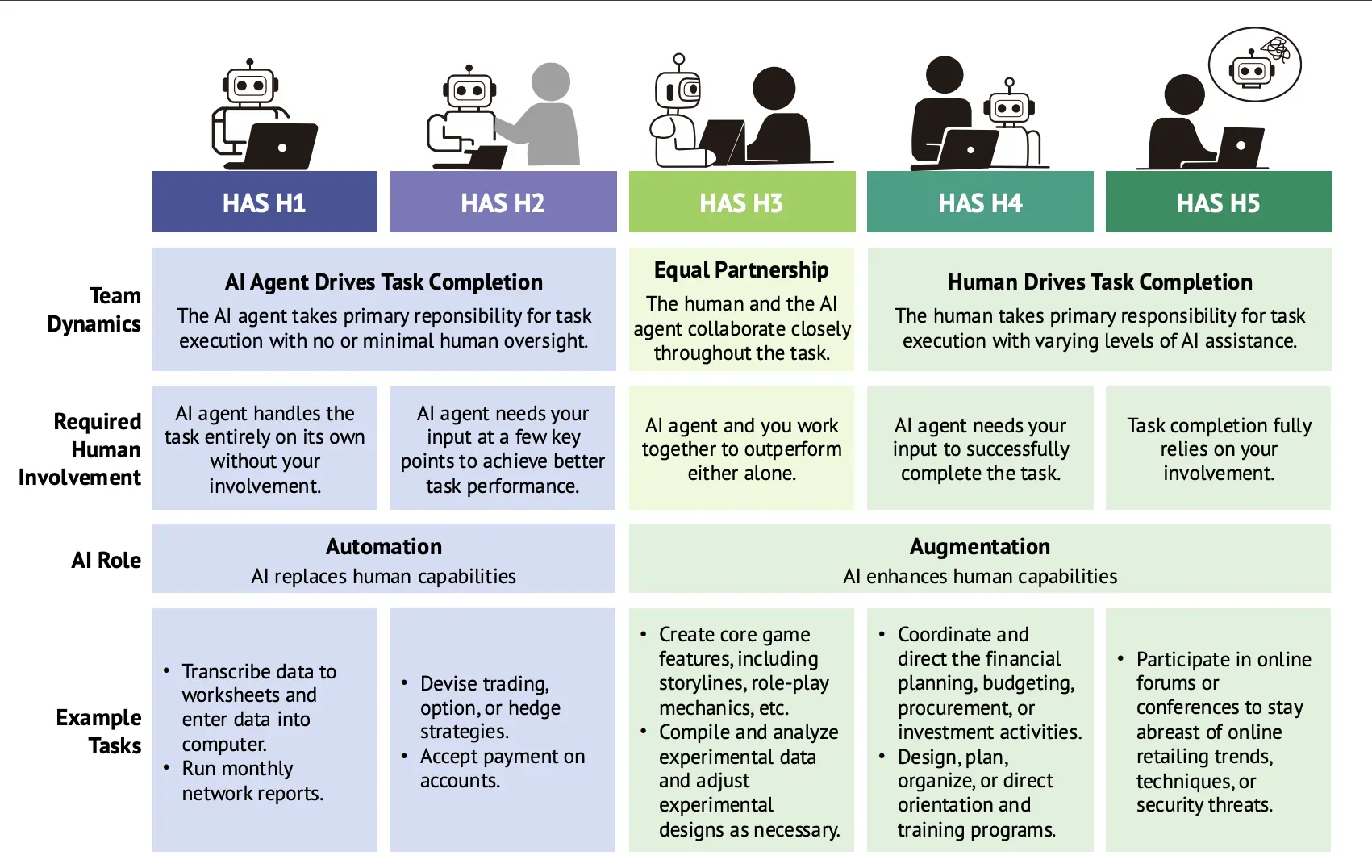
The study used audio-enhanced interviews to capture nuanced worker desires, moving beyond simple "automate or not" questions. Researchers introduced the Human Agency Scale (HAS), ranging from H1 (no human involvement) to H5 (human essential), providing a shared language for discussing AI integration.
Key findings challenge automation assumptions:
- Only 1.9% want full automation (H1) for their tasks
- 35.6% prefer H2 (AI support with human oversight at critical points)
- 16.3% choose H4 (human-led with AI assistance)
- Workers prefer higher human agency than experts deem necessary on 47.5% of tasks
What Is the Human Agency Scale and Why Does It Matter?
The Human Agency Scale represents a fundamental shift from "AI-first" to "human-centered" decision making. Instead of asking what can be automated, it asks what should be augmented and why.
The five levels provide clarity:
- H1: AI operates completely independently
- H2: AI requires minimal human oversight
- H3: Equal partnership between human and AI
- H4: AI serves as a tool needing substantial human guidance
- H5: AI cannot function without ongoing human input
H3 emerged as the dominant preference in 47 out of 104 occupations analyzed, making it the most common worker-desired level overall. This preference for collaboration over replacement challenges the industry's focus on maximum automation.
Why Do Workers Prefer AI Partnership Over Replacement?
Workers aren't resisting progress - they're defining it. When workers express automation desire, it's strategic, not surrendering control.
Among workers rating automation desire at 3 or higher (5-point scale), motivations were clear:
- 69.4% want time freed for high-value work (not that they want to automate high-value work)
- 46.6% seek relief from repetitive tasks
- 46.6% aim to improve work quality
- 25.5% desire stress reduction
Trust remains the primary barrier. Research shows 45% express doubts about AI accuracy and reliability, while 23% fear job loss and 16% worry about a lack of human oversight. Workers especially resist AI in creative tasks or client communication.
The pattern is consistent: automate the boring bits, amplify human strengths.
What Are the Four AI Adoption Zones Stanford Identified?
Stanford's zone framework maps worker desire against AI capability, creating strategic guidance for implementation:
Green Light Zone (High desire + High capability): Tasks like routine data entry, scheduling, and file maintenance, where workers welcome automation and AI delivers results.
Red Light Zone (Low desire + High capability): Areas where AI is technically capable but workers resist. Automating here risks resistance and reduced morale.
R&D Opportunity Zone (High desire + Low capability): Worker-desired areas where AI isn't ready yet. These represent valuable innovation frontiers.
Low Priority Zone (Low desire + Low capability): Neither workers nor technology are ready. Best to deprioritize.
The shocking discovery: 41% of current AI investments target Red Light or Low Priority zones, revealing widespread misalignment between development and worker needs.
How Is AI Changing Workplace Skills and Wages?
A wage reversal is underway. Traditional high-value information analysis roles are losing premium, while interpersonal skills gain value.
Recent research analyzing 12 million job vacancies (2018–2023) shows AI-focused roles are nearly twice as likely to require skills like resilience, agility, and analytical thinking compared to non-AI roles. Data scientists earn 5–10% higher salaries when they possess resilience or ethics capabilities.
The complementary effect dominates substitution. A doubling of AI-specific demand correlates with a 5% increase in demand for complementary skills, even outside AI-related roles. Complementary effects are up to 1.7x larger than substitution effects.
Skills commanding premiums include:
- Digital literacy and teamwork
- Resilience and agility
- Analytical and ethical thinking
- Interpersonal communication
My Take: The Partnership Path Forward
The Stanford study validates what many suspected: workers aren't afraid of AI - they're afraid of losing agency. The H3 preference isn't resistance to change; it's a blueprint for better change.
Smart organizations will focus on the R&D Opportunity Zone, developing AI capabilities workers actually want while avoiding Red Light implementations that breed resistance. The skills revaluation toward interpersonal competencies creates training opportunities for forward-thinking companies.
This isn't about slowing AI adoption. It's about aligning it with human values and workplace realities. The 41% investment misalignment represents wasted resources that could be redirected toward worker-desired automation.
The future belongs to organizations that view AI as augmentation, not replacement. Partnership scales better than domination.
Take Action: Pilot the Partnership Path
Don't just read about AI partnership - start your transformation this week. Block out two hours with your team and audit where your critical task data lives: CRM, spreadsheets, docs, shared folders, communication tools. Identify where manual workarounds or data-hunting eat up time - and note where workers wish tech helped, but doesn't.
Pick just one friction point that slows collaboration or drains creativity. It could be integrating project updates, syncing client feedback across teams, or unblocking key decisions. Try one practical step: automate or streamline that connection using a simple, low-cost tool or workflow improvement.
Curious what true partnership with AI can unlock for your organization? As your AI CxO Partner, I help leaders audit, design, and scale human-centered AI strategies - keeping your people empowered, not replaced.
👉 Subscribe to Dr. Hernani Costa | First AI Movers Insights for exclusive briefings, governance guides, and actionable playbooks. DM me on X (@FirstAIMovers) or email [email protected] for a complimentary AI audit or to discuss a tailored roadmap. Together, let's build workplaces where humans and AI thrive - no regrets, just results.
— by Dr. Hernani Costa | First AI Movers
About the Author: Dr. Hernani Costa founded First AI Movers Insights to translate breakthrough AI research into practical, people-first innovation. With 25+ years across technology, executive leadership, and academia, he guides teams and organizations ready to lead with trust, transparency, and sustainable advantage. For bespoke advice or a confidential 1:1, get in touch: [email protected].
Originally published at First AI Movers. Written by Dr Hernani Costa, Founder and CEO of First AI Movers.
Subscribe to First AI Movers for daily AI insights and practical automation strategies for EU SME leaders. First AI Movers is part of Core Ventures.
Ready to automate your business? Book a call today!
About the author
- PhD in Computational Linguistics. I build the operating systems for responsible AI. Founder of First AI Movers, helping companies move from "experimentation" to "governance and scale." Writing about the intersection of code, policy (EU AI Act), and automation.
Comments
Join the discussionNo comments yet. Be the first to comment.