
Microsoft Majorana 1: Quantum Computing for Enterprise
Quick Take: Microsoft's Majorana 1 quantum chip uses topological qubits for unprecedented stability, targeting enterprise applications from drug discovery to climate tech. This breakthrough positions Azure as the quantum computing platform for business transformation.
Microsoft's Majorana 1: Rewriting the Quantum Computing Playbook for the Enterprise Era
TL;DR: Microsoft's Majorana 1 quantum chip uses topological qubits for enterprise applications. Discover how this breakthrough transforms business automation.
In a breakthrough that could redefine computational limits, Microsoft has unveiled Majorana 1 - the world's first quantum chip powered by a Topological Core architecture. Described as the "transistor moment" for quantum computing, this innovation promises to solve industrial-scale challenges - from microplastic degradation to self-healing materials - in years rather than decades. For tech-savvy readers, here's how this leap alters the enterprise quantum landscape.
The Topological Breakthrough: Stability Meets Scale
Majorana 1's core lies a topoconductor, a novel material combining indium arsenide and aluminum. This enables the creation of Majorana fermions, exotic quantum particles that act as their own antiparticles. Unlike traditional superconducting qubits - which struggle with error rates above 1% - topological qubits embed error resistance directly into hardware. Key advantages include:
Scalability: Eight topological qubits now fit on a palm-sized chip, with a clear roadmap to 1 million qubits by 2030 - a threshold for tackling problems like enzyme optimization or carbon capture.
Digital Control: Voltage pulses replace finicky analog tuning, simplifying operations.
Cold Efficiency: Although the chip still requires near-absolute-zero temperatures (–273°C), its compact design enables deployment in Azure data centers.
Microsoft's Nature-published breakthrough confirms the precise measurement of Majorana states - a challenge since their theoretical prediction in the 1930s. Now a DARPA US2QC program finalist, the chip undergoes rigorous validation for national security applications.
Enterprise Applications: From Pharma to Climate Tech
Azure Quantum's upcoming integration with Majorana 1 opens three near-term verticals:
Materials Science: Simulating catalysts to break down microplastics into biodegradable compounds. Partners like BASF are piloting this technology to address the 14 million tons of oceanic plastic waste.
Drug Discovery: Accurately modeling protein folding for Alzheimer's therapies - a task where classical supercomputers can have error margins exceeding 40%.
Logistics Optimization: Solving traveling salesman problems for Fortune 500 supply chains, potentially cutting fuel costs by 15–30%.
Microsoft's "Quantum-as-a-Service" model via Azure lets enterprises experiment without hefty upfront infrastructure costs. Early adopters like Porsche already use smaller-scale quantum systems for AI-enhanced engine diagnostics.
Market Calculus: Microsoft vs. IBM vs. Google
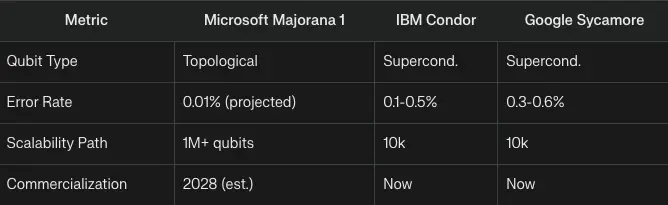
While IBM's 1,121-qubit Condor and Google's 70-qubit Sycamore dominate today's NISQ (Noisy Intermediate-Scale Quantum) era, Majorana 1 targets a fault-tolerant future:

Critics note that topological qubits remain unproven at scale, while IBM's Dr. Darío Gil emphasizes that "modularity beats moonshots" for near-term ROI. Yet Microsoft's $5B+ investment signals strong conviction - especially with OpenAI reportedly exploring GPT-6 training on future Majorana systems.
The Cold Reality: Challenges Ahead
Thermal Barriers: Despite its compact design, dilution refrigerators cost between $500k and $1M - prohibitive for many SMEs.
Algorithm Lag: Over 60% of quantum patents focus on hardware, while software tools like Q# lag behind Python-centric rivals.
Regulatory Risks: Export controls on indium arsenide - the key component in topoconductors - could complicate global rollout.
Microsoft's countermeasure is a Quantum Skills Initiative designed to train 100k developers by 2026, alongside open-source partnerships to port PyTorch to quantum-hardened AI models.
Strategic Takeaways for Tech Leaders
✅ Pilot Now: Azure Quantum's free tier offers limited Majorana access - ideal for prototyping material science workflows through AI readiness assessment.
✅ Hire Hybrids: Quantum-aware data scientists (fluent in Python and Q#) will help bridge the algorithm gap.
❌ Avoid Overcommitment: Hold off on fleet-wide investments until fault-tolerant benchmarks emerge around 2027–2028.
The Bottom Line: Majorana 1 isn't a quantum winter killer - it's a spring thaw. By solving stability first, Microsoft positions Azure as the AWS of quantum's Enterprise Age. For CTOs seeking digital transformation strategy, the play is clear: dabble today, scale tomorrow, and bet big on hybrid AI-quantum algorithms. Microsoft is not just building a faster computer - they're crafting a new lens to see nature's code.
Originally published at First AI Movers. Written by Dr Hernani Costa, Founder and CEO of First AI Movers.
Subscribe to First AI Movers for daily AI insights and practical automation strategies for EU SME leaders. First AI Movers is part of Core Ventures.
Ready to automate your business? Book a call today!
About the author
- PhD in Computational Linguistics. I build the operating systems for responsible AI. Founder of First AI Movers, helping companies move from "experimentation" to "governance and scale." Writing about the intersection of code, policy (EU AI Act), and automation.
Comments
Join the discussionNo comments yet. Be the first to comment.