
How LLMs Think: AI Memory & Logic Guide for Leaders

TL;DR: Master LLM mechanics including context windows, training data, and hallucinations. Transform basic AI usage into strategic enterprise advantage.
Quick Take: LLMs operate through training data, context windows, and predictive algorithms—not human-like reasoning. Understanding these mechanics transforms basic AI usage into strategic enterprise advantage. Master the fundamentals to architect sophisticated AI solutions.
How LLMs Think: Context Windows, Training, and Memory
To effectively leverage Large Language Models, you must understand how they "think." Their intelligence is not human-like; it is a unique form of digital cognition with specific rules and limitations. Grasping these concepts is what separates the amateur user from the strategic operator.
First is the training data. An LLM's knowledge is a direct reflection of the massive dataset on which it was trained. This is its entire universe of information. Since this data is historical, the model has no awareness of current events. Its answers are based on patterns from the past, not real-time information.
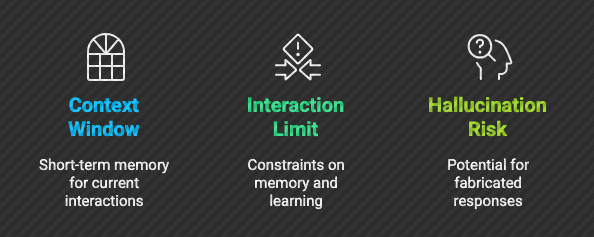
The concept of the context window is essentially the model's short-term memory. When you interact with an LLM, it can only "remember" the information within the current conversation or document, up to a certain limit. This window can range from a few thousand to over a couple of million words. Once information scrolls out of this window, it is forgotten. The model does not learn from your conversations or update its knowledge base permanently.
This is a critical limitation. An LLM cannot remember your preferences from one chat to the next. It cannot learn about your company's strategy over time. Every interaction starts with a blank slate, confined by the boundaries of its context window.
Finally, because LLMs are designed to predict the next word, they can sometimes "hallucinate"—a polite term for making things up. If a model doesn't know an answer, it might generate a plausible-sounding but completely fabricated response.
Understanding these mechanics is liberating. It allows you to move beyond simple prompting and architect more sophisticated solutions. You can design systems that feed the model real-time data, use external memory databases, and build guardrails to ensure accuracy. This is how you transform a consumer toy into a powerful enterprise asset.
Originally published at First AI Movers. Written by Dr. Hernani Costa, Founder and CEO of First AI Movers.
Subscribe to First AI Movers for daily AI insights and practical automation strategies for EU SME leaders. First AI Movers is part of Core Ventures.
Ready to automate your business? Book a call today!
About the author
- PhD in Computational Linguistics. I build the operating systems for responsible AI. Founder of First AI Movers, helping companies move from "experimentation" to "governance and scale." Writing about the intersection of code, policy (EU AI Act), and automation.
Comments
Join the discussionNo comments yet. Be the first to comment.