
B2B AI Product Architecture: Separate Billing Owner, Workspace, and Legal Entity Early

B2B AI Product Architecture: Separate Billing Owner, Workspace, and Legal Entity Early
TL;DR: A solid B2B AI product architecture separates the billing owner, workspace, and legal entity. Learn this model to avoid costly rework in permissions.
A practical model for founders and product leaders building multi-user AI products without creating rework in billing, permissions, and company identity.
When designing your B2B AI product architecture, one of the fastest ways to create expensive rework is to treat user, workspace, and company as the same thing.
It feels efficient in the first sprint. Your schema looks clean. Onboarding feels obvious.
Then reality hits. One person pays. Another invites teammates. A third edits the company profile. A project belongs to a working team. A legal identifier belongs to a real-world business. Suddenly your “organization” table is doing five jobs badly.
That is the moment when product debt turns into commercial debt.
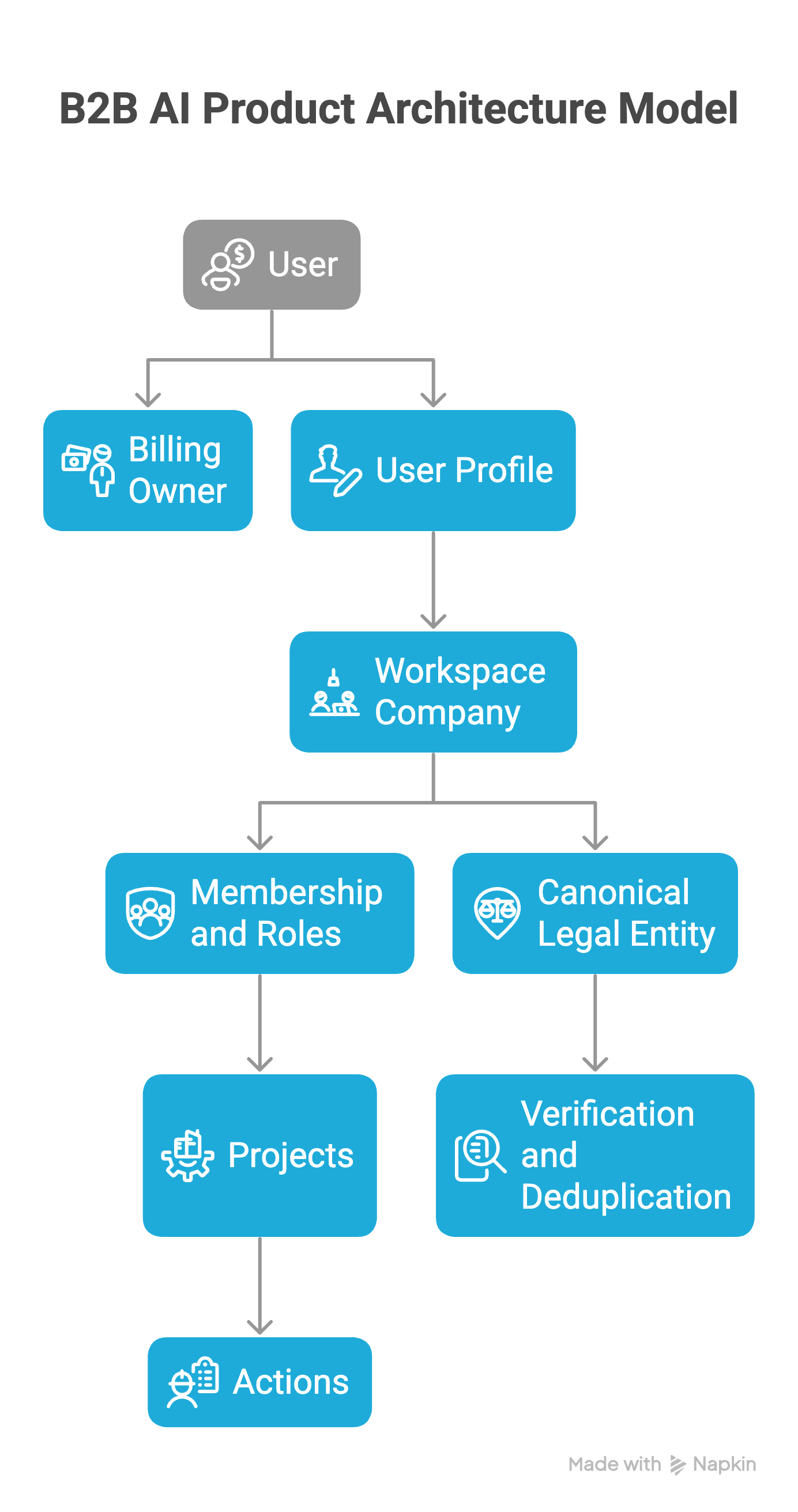
Billing owner, workspace, and company are different jobs
Most early teams frame the problem as a binary choice: users or organizations.
That framing is too shallow for serious B2B software.
The real design questions are simpler and more useful:
Who pays? Who collaborates? What operational state belongs to the team? What legal identity must match the outside world?
Those are different jobs. They should not be forced into one record.
In my experience, this is where early AI products get trapped. Teams optimize for schema neatness instead of accountability. The result is predictable: billing gets muddy, permissions get messy, and enterprise buyers start seeing risk where you thought you had simplicity.
The clean rule for v1 is this:
Use one billing-root user. Use a workspace for operational collaboration. Keep legal-entity matching as a separate concern.
The market leaders already centralize accountability
If you want a practical signal, look at how the platform leaders structure control.
OpenAI’s ChatGPT Business workspace separates Member, Admin, and Owner roles. Only Owners can view plans and invoices under Billing. In ChatGPT Enterprise and Edu, Owners have full access, including billing, identity management, and workspace configuration. (read)
Anthropic follows the same pattern. Claude Team and Enterprise organizations can have only one Primary Owner. Anthropic also states that only Owners and Primary Owners can access billing, while admins can still manage members and operational settings. (read)
The lesson is not that your product needs to copy OpenAI or Anthropic feature for feature.
The lesson is architectural:
keep accountability concentrated at the top, then layer collaboration underneath.
That is the right shape for most v1 and v2 B2B AI products.
Legal identity is not the same as workflow identity
This gets even more important in European contexts, where company identity is not just a free-text field.
In the Netherlands, businesses receive a unique 8-digit KVK number when they register in the Dutch Business Register. KVK states that every business has only one KVK number, even if it has multiple activities or trade names. KVK also notes that legal entities and partnerships receive an RSIN, while sole proprietorships do not. (read)
That matters because a real-world business identity is not the same thing as an operational workspace inside your product.
Two users may refer to the same legal company and still need different operational realities:
different saved opportunities different projects different notes different partner choices different internal workflows
If you hard-merge those realities too early, you do not create elegance. You create permission debt.
The better pattern is this:
Workspace company: the operational object inside your product Canonical legal entity: the verified real-world business identity you may link later
That gives you flexibility now and integrity later.
Premature deduplication feels smart and causes damage
A lot of teams try to solve this with aggressive matching logic.
KVK plus country plus postcode plus address. Done.
Not done.
That may become useful later for canonical matching, enrichment, fraud checks, or compliance workflows. It is not a strong default for operational state when collaboration semantics are still immature.
Here is the hard truth:
deduplication is easy to justify and painful to reverse.
If your application is still figuring out ownership, membership, visibility, and audit behavior, hard deduplication is usually a premature optimization.
You should treat these as separate questions:
Is this the same legal entity? Is this the same working context?
Those answers are often not the same.
If you blur them too early, your product starts leaking state across workflows that should stay separate. That hurts user trust, slows product iteration, and makes enterprise conversations harder because the platform starts looking ambiguous exactly where buyers want clarity.
The v1 model I would implement now
If you are building over the next two quarters, this is the model I would recommend, reflecting the principles we apply in our AI Strategy Consulting.
1. User is the billing root
This user owns the subscription, receives billing notifications, and acts as the first accountable commercial owner.
That does not mean the product is single-user.
It means your commercial control point is clear.
2. User profile is separate from auth identity
Keep authentication and editable profile data separate.
Your users table should stay focused on authentication, stable identity anchors, and access primitives.
Your user_profiles table should hold mutable business details such as name, title, VAT-related fields, notification preferences, and onboarding progress.
This separation reduces coupling and gives you a cleaner foundation for profile changes, audits, and future workflow logic.
3. Workspace company owns operational state
This object should own the team’s working reality inside the app:
saved opportunities projects fit answers notes drafts shared context
This is where collaboration lives.
4. Membership and roles sit between user and workspace
Do not bury access logic inside the company record.
Model memberships and roles explicitly.
That gives you a clean path for owner, admin, contributor, and viewer permissions without rewriting the data model later.
5. Canonical legal entity is a separate layer
This is where registry-backed identity belongs:
KVK branch number legal structure country-specific identifiers enrichment metadata compliance metadata
This layer should support verification and deduplication without forcing all workspaces into a single merged operational object.
6. Projects can be workspace-scoped while actions remain user-attributed
This is the part many teams miss.
A project can belong to the workspace company.
Actions on that project can still be attributed to users:
who changed status who answered fit questions who added notes who approved outreach who pushed the workflow forward
That gives you shared state without losing accountability.
The 3-Layer Model for B2B AI Product Architecture
Layer 1: Commercial owner Who pays, receives invoices, and owns the commercial relationship.
Layer 2: Operational workspace Where the team works, shares context, and manages live state.
Layer 3: Canonical legal entity The verified real-world business identity used for matching, enrichment, and compliance.
If one table is trying to do all three jobs, you probably have a future problem.
Further Reading
Written by Dr Hernani Costa, Founder and CEO of First AI Movers. Providing AI Strategy & Execution for Tech Leaders since 2016.
Subscribe to First AI Movers for practical and measurable business strategies for Business Leaders. First AI Movers is part of Core Ventures.
Ready to increase your business revenue? Book a call today!